Dr. Brandon A. A. J. Davis, Columnist
Most people can recall where they were when significant events changed the course of American history. I remember my grandmother telling me that she was resting on the side of her bed when she heard the news over the radio that Dr. Martin Luther King, Jr., had been assassinated. Such moments become permanently etched into our memories, marking not simply where we were, but who we were when history interrupted our lives.
On June 17, 2015, I was leaving an event in Boardman, Ohio, when Presiding Elder Aimee Hurst Anderson called my cell phone and said, “Turn on the news.” I explained that I was not at home and asked what was happening. She replied that there had been a major shooting at one of our Churches in South Carolina. I immediately searched Google for breaking news but found little information. I began calling friends in the area. The Rev. Fedrick A. Wilson was the first to answer, informing me that nine people, including my friend and fraternity brother, the Honorable Rev. Clementa Carlos Pinckney, had been killed.
I spent the remainder of that evening calling friends and colleagues, desperately trying to understand what had happened to my Church. I later learned that the Rev. Jarrett B. Washington had been in downtown Charleston and was headed toward the church when the killings occurred. Thankfully, he was unharmed. Throughout the night, I remained glued to every available news broadcast and social media update, speaking with friends and colleagues who were equally devastated.
The following morning, I went to work. A member of my congregation at the time, Historic St. Andrewes AME Church in Youngstown, Ohio, arranged for a news crew to visit my office to discuss the terrorist attack. As pastor of a leading AME congregation in the area, I naturally became a spokesperson. That day alone, I participated in seven interviews. Finally, that day, with the assistance of a friend, I organized an impromptu prayer vigil, inviting clergy colleagues and community members to gather in prayer for the victims, their families, and a congregation whose sacred space had been violated by hatred.
As the days passed, I watched the funeral services and made arrangements to attend the funeral of the Rev. Senator Pinckney at TD Arena in downtown Charleston. I felt obligated to attend, not simply because he had recommended me for membership in Alpha Phi Alpha Fraternity, Inc., nor because he was an alumnus of Allen University whom I deeply admired for his intellect and commanding voice. I felt obligated because a wolf had entered a sanctuary and murdered a shepherd and his sheep simply because they were Black.
Eleven years later, that reality remains difficult to comprehend. When my editor, Dr. John Thomas, asked whether I would cover the unveiling of the Emmanuel Nine Memorial, I immediately accepted. Like so many others, I carry a personal connection to the tragedy — a sacred remembrance that forever binds me to the events of June 17, 2015. I have never fully forgotten what happened inside a house of worship that has long stood as a symbol of liberation, transformation, unity, and love.
Nor have I fully comprehended how the gracious act of welcoming a stranger into Bible study could be met with such calculated hatred. I’ve never quite fully been able to comprehend how the power of loving and welcoming peoplewasresponded towith such vitriol and hate. How was it possible that a terrorist was capable of resisting the drawing power of love — enough to kill God’s children in God’s own house? These were the questions that accompanied me as I traveled from Bluffton to Charleston.
Eleven Years Later: Remembering the Emmanuel Nine
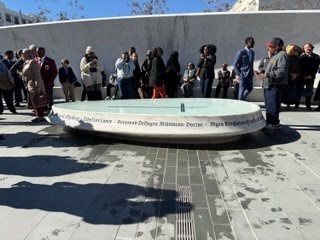
Now, eleven years later, we gathered at Mother Emanuel AME Church to open a permanent structure and dedicated space to honor the lives of Cynthia Graham Hurd, Tywanza Kibwe Diop Sanders, Susie Jackson, Ethel Lee Lance, Myra Singleton Quarles Thompson, The Rev. DePayne Middleton-Doctor, The Rev. Sharonda Coleman-Singleton, The Rev. Daniel Lee Simmons, Sr., The Honorable Rev. Clementa Carlos Pinckney.
On the evening I arrived in Charleston, I met with South Carolina State Rep. Hamilton Grant (D– Richland County), the grandson-in-law of the late Rev. Daniel Lee Simmons, Sr. Our conversation centered on the life and legacy of a man beloved throughout South Carolina and the connectional African Methodist Episcopal Church. Rev. Simmons was a former pastor, a candidate for episcopal honors, and, after retiring, a devoted pulpit associate at Mother Emanuel.
During our interview, Rep. Grant reflected on the troubling reality that, more than a decade after the terrorist attack, South Carolina remains one of only two states without a comprehensive state hate-crimes law, the other being Wyoming. Our conversation moved beyond remembrance to the pressing need for meaningful legislation that protects citizens against hate-motivated violence. Rep. Grant emphasized the importance of changing the public conversation around such legislation and called for a renewed commitment to civility, both statewide and nationally.
He spoke of treating our neighbors with human kindness and moving beyond partisan ideologies that too often obstruct meaningful community change. When discussing the memorial itself, his words carried both the weight of personal loss and the tenderness of familial remembrance. Rep. Grant described the memorial as beautiful and reflected on what it meant for him and his wife, Alana, to share a private viewing with their three children.
Sacred Ground and the Responsibility of Remembrance
After our conversation, I began reviewing remarks from Dr. Eric S. C. Manning, Senior Pastor of Mother Emanuel AME Church; Bishop Francine Angelique Brookins, Presiding Prelate of the Fifth Episcopal District; and Bishop James Levert Davis, Presiding Prelate of the Seventh Episcopal District, the Nation State of South Carolina. Throughout his remarks and public presentation of the memorial, Dr. Manning returned to a profoundly theological understanding of remembrance: “This is sacred ground because memory itself can become sacred work.”
He further declared: “We do not celebrate suffering, violence, or the loss that families and a congregation continue to carry; instead, we commemorate, consecrate, remember, and bear witness.” His words remind us that remembrance is more than an exercise in historical recollection. It is a sacred responsibility. To remember is to resist the temptation to forget, to confront the realities that produced such violence, and to ensure that the lives of the innocent are never reduced to another tragic chapter in American history.
Bishop James Levert Davis, who was unable to attend, offered these words in his submitted remarks: “We recognize that the passage of time does not ease grief, and this historic moment carries both the weight of sorrow and the promise of hope.”
Bishop Francine Angelique Brookins, who also could not attend because of pressing responsibilities within her jurisdiction, affirmed that the Emanuel Nine remain alive in Christ.
Her words carried an unmistakable prophetic challenge: “Hatred could not extinguish their light or separate them from God’s love. May this nation remember their precious lives, their faith, love, and service—and repent of racism, white supremacy, and the indifference that allows injustice to endure. May that repentance bear fruit in changed hearts, just policies, and accountable institutions.”
Such words move the memorial beyond the boundaries of ceremonial dedication. They remind the Church and the nation that genuine remembrance must produce moral responsibility. Repentance cannot remain confined to public statements or solemn observances; it must become visible in transformed hearts, equitable laws, and institutions accountable to the dignity of human life.
The Unveiling: A Sacred Moment in Charleston
The unveiling ceremony was brief, yet dignified and deeply meaningful. The crisp, 50-degree weather may have contributed to the program’s brevity, but it did little to diminish the solemnity in the air. A large gathering assembled beneath the balcony steps of Mother Emanuel as Dr. Manning, Deona Smith, Executive Director of the Mother Emanuel Memorial Foundation; John Darby, Foundation Co-Chair and Chairman and CEO of The Beach Company; and Charleston Mayor William S. Cogswell, Jr., offered remarks preceding the official unveiling.
There was something profoundly moving about standing among people gathered not merely to observe the dedication of a memorial, but to bear witness to the enduring significance of nine lives whose deaths exposed the continuing presence of racial hatred in American society. The gathering represented more than an occasion of remembrance. It acknowledged that the sacred history of Mother Emanuel did not end on June 17, 2015. The church that had survived persecution, racial oppression, and generations of struggle had once again demonstrated that the forces of hatred could neither destroy its witness nor extinguish its light.
As I made my way through the crowd to see the memorial for myself, I was overwhelmed by the magnitude of the moment. Once the memorial came into view, its significance began to settle upon me. I thought about the nine lives taken, the families forever changed, the congregation whose sanctuary had been violated, and the Church that refused to surrender its witness to the darkness of hatred. Strangely, the memorial made the tragedy of a violent loss and Mother Emanuel whole again.
As I sat on the memorial bench, which was shaped like angels’wings, I thought these words: “Holy ground has risen from the ashes of bitter strife, tragedy, and misfortune. Evil entered a house of God, the dwelling place of God’s Spirit, and murdered a shepherd and eight members of his flock. Yet, from evil’s dark abyss, light beneath the cross of Jesus Christ shines– permanently!”
The Emmanuel Nine Memorial stands as a permanent structure, with a survivors’ garden planned for 2027. The memorial itself is a witness that hatred does not have the final word. The memory of the righteous remains, the sacred responsibility of justice endures, and the light of faith continues to shine. Eleven years later, beneath the cross, the light still shines. Amen.
Rev. Dr. Brandon A.A.J. Davis is the Senior Pastor, Historic Campbell Chapel AME Church, Bluffton, South Carolina, and a Columnist for The Christian Recorder.