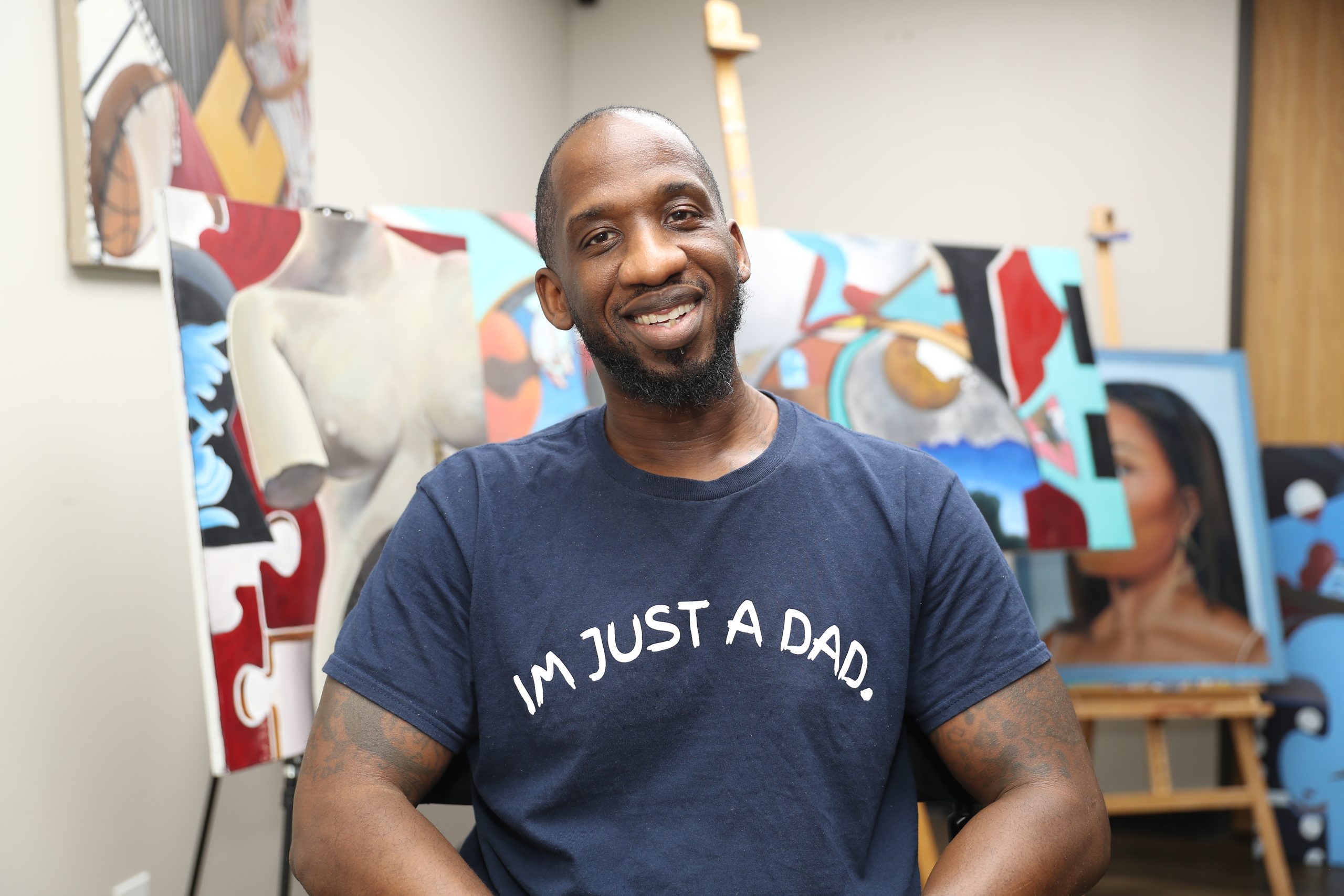
Kevo Aregbe married his wife, Malenda, in February 2024. Within days, she was in the hospital, and by Valentine’s Day she was brain-dead from a cancer neither of them knew she had.
She was the one who pushed him to put his plays on stage. He decided to keep going.
Since December 2023, the Houston playwright, director, and producer has written, directed, financed, and staged a string of original full-length plays, a pace RecordSetter recognized as a world record, while raising two daughters, Meliza (13) and Maïtè (3) alone, teaching college art, and running his tattoo studio.
“I don’t think people understand how hard it is to do one play in your life,” Aregbe said. “It’s hard to stare at a blank screen with nothing on it and create a story in your head, create characters, write it out.”
Raised by an aunt, Aregbe has a hard life and spent much of his time in the streets dealing drugs. While he did his punishment at home, he would spend time drawing and watching movies on mute.
By his own account, he later cycled through juvenile detention and jail, survived being shot and stabbed, and served more than a year behind bars, where he kept writing. In 2010, he quit selling drugs and opened a tattoo shop. Houston artist Patrick Palmer read Aregbe’s writing about art and told him he was bigger than tattooing.
Aregbe went on to study art at the University of Houston and found a local arts scene he calls “small, but big.” He now teaches art history, drawing, and painting at Houston Community College and Lone Star College, including a lesson on tattooing synthetic skin.
Building from the ground up
Kevo Aregbe showcases the full productions he’s created throughout the years. Credit: Jimmie Aggison
Aregbe met Melenda at a poetry event, and going to plays became their thing. One day she found stage plays on his computer and picked What Do We Do Now?, a nonlinear story that folds Black American history from the 1940s to the 2000s into the life of one family. When the budget didn’t add up, she put two of her paychecks toward the theater and technical costs.
“I feel like she was my first producer,” Aregbe said. “Once she did that, I kind of learned, okay, this is how I got to cover the next play.”
His oldest daughter, Meliza, noticed something he had missed. Nearly every play since has a woman in the lead.
“I was really, in a way, kind of taking small things I liked about her and putting them in my lead character,” he said. “I didn’t even realize I was doing that.”
Balancing fatherhood and art alone has been hard for a self-described workaholic, but he wants his daughters to see a good example of a Black man.
“I’m living what I’m talking about,” Aregbe said. “I’m not just putting on for the internet.”
Producing, Aregbe said, is where most artists freeze. He has paid for shows with Houston Arts Alliance grants and tattoo income, and by his third play he had a formula. The steepest cost, he said, is time.
Half of his plays explore African American culture, from slavery to Mansa Musa, and the rest retell history he loves, including Cleopatra, staged in October at MATCH.
What Houston is missing
The son of a Black American mother and a Nigerian father, Aregbe said Houston has the funding but not the spotlight. Local media rarely covers independent artists, he said, and a list of nearly 100 Houston plays once left his name off, even as emails arrived from New York, Chicago and Los Angeles.
He also wants more support from his own communities. Most of his audiences are white, and many Nigerians he meets have no idea what he does.
“When I was in the streets, I had all the support in the world,” Aregbe said. “When we start doing things that are more valuable to sustain, we should support it a little bit more.”
Few people have watched him carry that load as closely as Kasey Bass. An actress, model, and stunt performer who has worked in film and television mostly around Houston, Bass also teaches English at the University of Houston. A fellow actor recommended her for one of Aregbe’s table reads, and what struck her first was not his directing but his scholarship.
“Each one of his plays is researched to that degree,” Bass said. “There’s so much history that goes into it and so much thought, and it’s all his own unique spin on it.”
Two or three months after that table read, his wife died. Bass barely knew him, but she went to the funeral. A single mother of five whose children are close in age to his daughters, she reached out to tell him he was not alone.
“I don’t think people understand how hard it is to do one play in your life. It’s hard to stare at a blank screen with nothing on it and create a story in your head, create characters, write it out.” Kevo Aregbe
“I’ve been on my own with young kids,” Bass said. “I don’t know exactly what that was for him, but I know what it was for me.”
She has since acted in five of his productions, playing a different character each time, and watched him handle load-ins, rehearsals, and backstage logistics with an ease she calls effortless. That trust led her to bring two of her children to watch rehearsals for Cleopatra.
“I want them to see that this is possible, that this is something that they could do,” Bass said. “I know he’s inspiring lots of kids, not only his own.”
Bass now hopes to develop college English courses around his scripts, which she sees as multicultural stories that resonate differently with each audience member.
“They definitely deserve to be studied,” Bass said. “I anticipate that as he grows his body of work, that will definitely grow beyond Houston.”
Aregbe wants to eventually leave Houston for Broadway work as a writer or director, but that is not the finish line. What drives him is hearing from audiences that they learned something.
“It’s kind of cool to make education entertaining,” he said. “It’s just to grow what I’m doing, not have it just here in Houston. Let the world see it.”


