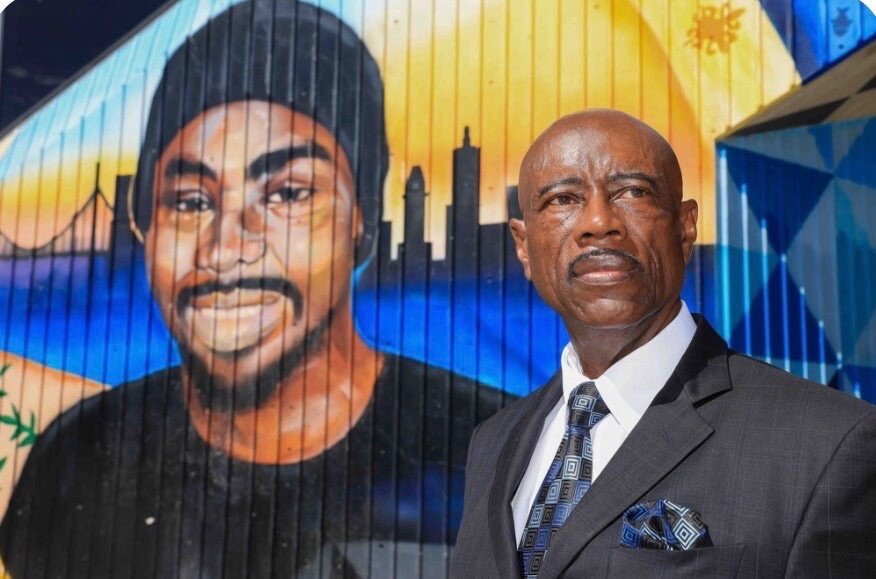
Cephus “Uncle Bobby” Johnson stands beside a mural of his nephew Oscar Grant. Since Grant’s killing by BART police in 2009, Johnson has worked alongside impacted families to demand police accountability.
by JR Valrey
Black people have been organizing against police terrorism in Oakland since the murder of Black Panther Lil Bobby Hutton in the ’60s. In 2003, a group of Oakland police nicknamed the Riders was exposed after committing hundreds of human rights violations. The city of Oakland doled out over $100 million after being sued, and the department was under federal oversight until three months ago.
Oakland also got international attention in 2009 after BART police officer Johannes Mehserle murdered Oscar Grant on the Fruitvale BART platform and a number of rebellions in the streets of downtown followed. In 2015, the Town was rocked by a human trafficking case in which a teenage “Celeste Guap” was being trafficked by approximately a dozen law enforcement agencies in the Bay Area. Once the scandal broke in the media, Oakland police officer Brendan O’Brien committed suicide.
If there was anybody from the Bay Area community who is an expert on police terrorism and murder, as well as the quest for justice that ensues following these tragic encounters, it is Cephus “Uncle Bobby” Johnson, the uncle of Oscar Grant, who has not left the front lines in the battle for police accountability since the murder of his nephew. I wanted our readers to get an update on the work he is involved in, as well as his opinion on what is being promoted as “progress within the department” by the current Black mayor Barbra Lee, who posed for photos with the OPD brass at a recent press conference announcing the end of almost two and a half decades of federal oversight.
JR Valrey: Recently, federal oversight was lifted on the Oakland Police Department after 23 years, while a scandal is currently underway regarding Oakland police pilots falsifying flight logs, among other violations. Do you think that the Oakland Police Department deserved to be let off the status that put them in the category of being one of the worst police departments in the U.S.?
Uncle Bobby: No. In my view, lifting federal oversight was premature. Twenty-three years under supervision should require clear evidence that accountability has become part of the department’s culture. Oakland deserves to see change in how officers treat residents, how complaints are investigated and whether misconduct brings meaningful consequences.
I recognize that reforms have been made and that the attorneys who represented the plaintiffs supported ending oversight. But even shortly before that decision, the federal monitor reported that OPD had fallen short of its requirement for timely investigations of serious misconduct. That gives me reason to question whether those reforms are sustainable.
The helicopter case deepens my concern. Federal prosecutors allege that two officers obtained pilot certifications through false submissions and that one falsified flight records to obstruct the investigation. Both officers pleaded not guilty, and prosecutors must prove those allegations. Still, allegations involving dishonesty and public safety demand independent scrutiny and public answers.
As someone involved in police oversight, I want to know: Who supervised this unit? What safeguards were in place? Were warning signs missed? And how will the community know that the investigation was thorough?
For Black communities that have carried the burden of police misconduct, trust has to be earned through consistent action. Ending federal oversight does not end Oakland’s responsibility. Independent civilian oversight must have the resources, access and authority to hold officers and their leadership accountable. The public deserves transparency, consequences when wrongdoing is established and lasting protection of our civil rights.
JR Valrey: Can you tell us about the board that Gov. Newsom appointed you to? What have you and the board been able to accomplish since you’ve been there?
Uncle Bobby: Governor Gavin Newsom appointed me in 2023 to California’s Peace Officer Standards Accountability Advisory Board. It is a nine-member board created through Senate Bill 2, with a majority of seats reserved for people who are not current or former police officers. That matters because communities affected by police misconduct need a voice in decisions about who should have the authority to police us.
Our responsibility is to review serious-misconduct cases in public hearings and recommend whether an officer’s certification should be suspended or revoked. These cases can involve dishonesty, excessive force, sexual assault, racial bias and other serious abuses. Decertification means taking away an officer’s eligibility to serve as a peace officer in California. It provides a way to prevent an officer whose certification has been revoked from simply moving to another department and continuing to police another community.
Since I joined, the board has held public hearings, examined investigative findings and made recommendations for accountability. One recent example is our July 2026 hearing, when the board recommended revoking two officers’ certifications. In September, the POST Commission unanimously upheld both recommendations. Those cases still have additional proceedings ahead, so we must distinguish a recommendation from a final revocation. But that is concrete progress toward accountability.
My contribution is bringing the experience of impacted families into that process. As Oscar Grant’s uncle, and through my work with families who have lost loved ones to police violence, I understand that behind every case file are people whose lives have been changed forever. I bring that understanding to the evidence we review and the responsibility we carry.
I believe we have helped create a public forum where serious misconduct can be examined beyond an officer’s own department. But I would never tell Bay View readers that having a board means the struggle is over. We must keep demanding thorough investigations, timely decisions, transparency and meaningful consequences. For me, this appointment is another place to carry the families’ demand for justice and the community’s right to safety.
JR Valrey: What has been the biggest thing that you learned or have been surprised about since being appointed to the board?
Uncle Bobby: The biggest thing I have learned is how much distance there can be between passing an accountability law and delivering accountability to the people. Families fight to get legislation passed, but implementation requires continued attention. We still have to examine the evidence, ask difficult questions and make sure the process fulfills the promise made to our communities.
Serving on this board has reinforced for me how important it is to distinguish an investigation, a recommendation and a final decision. Those stages matter, but for a family waiting for answers, the process can feel painfully slow. We have a responsibility to be thorough and fair while remembering that delays affect real people.
I come to this work as Oscar Grant’s uncle and as someone who stands with impacted families. I understand what it means to have your loved one discussed as a case while you are carrying a loss that never leaves you. That experience shapes how I approach this responsibility. I want families to know that their loved ones’ humanity belongs in the room alongside the evidence.
What has become clearest to me is that community participation must continue after a law is signed. We need people watching the hearings, asking questions and holding institutions accountable for their promises. My appointment gives me a seat at the table, and I take seriously the responsibility to bring the concerns of families and our communities to that table.
Accountability requires sustained work. A law opens the door; we have to keep pushing to make sure it delivers meaningful protection for the people.
JR Valrey: Can you talk about being appointed to the BART police board? How long is your term? What do you have the power to do?
Uncle Bobby: Being appointed to the BART Police Civilian Review Board has deep personal meaning for me. As Oscar Grant’s uncle, I carry the memory of my nephew and the responsibility to help protect others. Our family and community understand why independent oversight of BART Police matters.
The BART Board of Directors appointed me to the Public-at-Large seat. That means I serve the broader community rather than one director’s district. My current term runs through June 30, 2028, and I am eligible for reappointment. Regular board terms are two years.
As a member, I can review the Independent Police Auditor’s investigative findings, vote on findings and disciplinary recommendations and help recommend changes to police policies, practices and training. The board also receives misconduct complaints and participates in community outreach so people understand their rights and how to raise concerns.
Our role in discipline has real significance. When the board agrees with the auditor’s findings and recommended discipline, the police chief must implement the recommended action unless it is appealed, subject to applicable due process requirements. If the board disagrees with the auditor and we cannot resolve that disagreement, the board can appeal to the general manager. These are powers exercised collectively; I cannot personally fire an officer or order an investigation.
I intend to use my voice and vote to ask difficult questions, examine the evidence fairly and press for meaningful accountability. I also want to strengthen outreach, because an oversight system can only serve the community when people know it exists and can access it.
For me, this appointment is a responsibility to the people who ride BART, to impacted families and to Oscar’s memory. Every person deserves to reach their destination safely and be treated with dignity.
JR Valrey: What are your thoughts on BART police? Have they made any progress on dealing with people in a humane way since the murder of your nephew Oscar Grant?
Uncle Bobby: Yes, BART Police have made progress since the murder of my nephew Oscar Grant. I can acknowledge those changes while continuing to demand evidence that people are being treated humanely and that officers are held accountable.
BART now has an Independent Police Auditor and a civilian review board. It requires body cameras, has strengthened its use-of-force policies and requires officers to attempt de-escalation and intervene when another officer uses excessive force. Those are meaningful safeguards when they are followed and enforced.
I also see promise in the use of unarmed Transit Ambassadors and Crisis Intervention Specialists who can connect people with mental health, housing and other services. Someone experiencing a crisis needs patience, care and an appropriate response. Expanding those options is a step toward more humane treatment.
But policies and training alone cannot tell us how every person is being treated on a platform or inside a train. I want to know what happens during the actual encounter: Did the officer listen? Did they give the person time and space? Was force necessary? If someone complained, was that complaint taken seriously?
For Black riders, young people, unhoused people and people experiencing mental health crises, dignity must be part of public safety. Nobody’s circumstances make their life less valuable.
As Oscar’s uncle, I will always carry what happened to him. As a board member, I have a responsibility to examine the evidence fairly, recognize improvements and challenge failures. My measure of progress is whether people are safer, their rights are protected and misconduct brings meaningful consequences.
Oscar should have made it home. I want every family using BART to have that assurance for their loved ones.
JR Valrey: Can you talk about the work that you have been doing outside of California with victims and families of victims of police terrorism?
Uncle Bobby: Outside of California, my work has focused on connecting families who have lost loved ones to police violence and helping build a national movement led by impacted families. Through the Love Not Blood Campaign and the National Families United 4 Justice Network, I work to bring families together so they can support one another, share their experiences and strengthen their demands for accountability.
When police kill someone you love, the struggle continues long after the headlines disappear. Families are grieving while trying to get records, understand investigations, find legal support and challenge narratives that can strip their loved one of their humanity. I know that pain as Oscar Grant’s uncle. I bring that understanding into my work with other families.
One of the most important things we can do is help families recognize that they do not have to face this alone. Connecting across state lines allows us to learn from each other and recognize recurring problems – delayed answers, barriers to transparency and the difficulty of holding officers and institutions accountable.
I believe impacted families must have a meaningful voice in shaping the solutions. We have knowledge that comes from living through the consequences of police violence. That experience belongs in discussions about investigations, oversight, legislation and public safety.
This work is also about caring for one another. Families need spaces where they can speak their loved one’s name, tell the truth about who they were and be heard without having to defend their grief.
My commitment extends beyond California because the pain and the demand for justice extend beyond California. We are building relationships that can sustain families through a long struggle and help turn our shared experience into collective action. Every family deserves answers, support and a real opportunity to pursue justice.
JR Valrey: How could people get in touch with you?
Uncle Bobby: People can reach me by email at [email protected], call me at 510-706-7558 or visit www.lovenotbloodcampaign.com to learn more about the Love Not Blood Campaign.
Whether you are an impacted family seeking support, someone interested in getting involved or a community member working for police accountability, I welcome you to reach out. We need each other in this work, and building those connections is how we strengthen our collective voice.
JR Valrey is a veteran journalist and Editor in Chief at the San Francisco Bay View. He can be reached at [email protected]