A 27-year-old White House policy adviser was reviewing internal documents during his commute on Washington’s Orange Line.
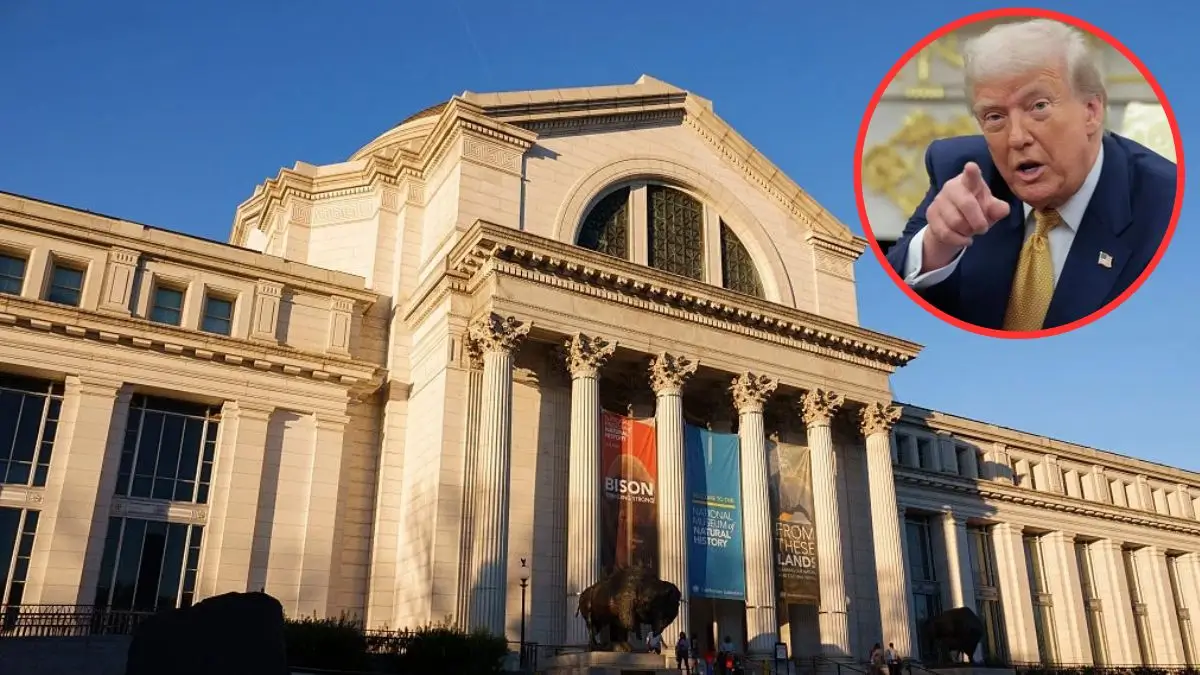
A Trump staffer exposed sweeping plans to overhaul the Smithsonian, fueling outrage over his control of American institutions and raising security concerns. (Photo: by Kevin Carter/Getty Images; Chip Somodevilla/Getty Images)
What to Know A 25-point proposal reportedly outlines sweeping changes to the National Museum of American History.
The proposal reportedly calls for the removal of approximately a dozen senior museum officials and curators.
The incident raises fresh concerns about how White House staffers handle sensitive government documents in public spaces.
Donald Trump has made it clear that America’s most recognizable institutions are not beyond his reach.
The president has taken a growing interest in shaping how the nation presents, celebrates, and sometimes rewrites its history.
Now, an apparent slip-up by someone working inside his administration has raised fresh questions about just how far the president intends to go.
Trump’s secret plans to overhaul the Smithsonian have come to light after a White House staffer’s careless move on a train exposed the details.
An ordinary commuter reportedly got an unexpected look at what the White House may have planned next.
According to a Nov. 23 ProPublica investigation, a White House staffer was spotted aboard Washington, D.C.’s Orange Line Metro train. The staffer was working on a document titled “Smithsonian Institution Renewal Plan.”
A fellow passenger photographed the laptop screen and sent the images to the investigative newsroom.
Officials identified the man as Sam Bock, a 27-year-old associate policy adviser on Trump’s Domestic Policy Council.
He was reportedly reviewing a 25-point proposal that could dramatically change the Smithsonian’s National Museum of American History.
Among the proposals were firing museum director Anthea Hartig and approximately a dozen senior administrators and curators. The document also called for exhibitions celebrating Western civilization, prominent American families, and George Washington.
Another proposal would overhaul educational programming to emphasize patriotism while reconsidering diversity-related guidelines and outside partnerships.
The White House has not confirmed that the draft represents an approved policy. However, several proposals closely resemble demands Trump has already made publicly.
In his Sept. 11 Truth Social statement, Trump accused museum leadership of emphasizing ideology over American accomplishments.
“Instead of focusing on ideological activism, the leaders of America’s taxpayer-funded, National History Museum should be focused on telling America’s story—fairly, accurately, and coherently,” he wrote.
He also demanded that the museum replace its Infinity sculpture with a 30-foot statue of George Washington and create a five-year exhibition honoring the nation’s first president.
“Replace a sculpture that says nothing about America with the man who, more than anyone else, says everything about America,” Trump declared.
The latest revelation follows months of pressure on the Smithsonian, including a 162-page White House report accusing museum leadership of promoting radical ideology.
The administration also proposed spending $84,000 on warning signs outside the museum to criticize its historical presentations.
Smithsonian Secretary Lonnie Bunch, the institution’s first Black leader, announced his departure amid the escalating dispute. Bunch helped establish the National Museum of African American History and Culture, which Trump praised in 2017 as a shining example of African-American contributions.
On X, many people have weighed in on the leaked documents with outrage.
“We Americans CANNOT ALLOW THIS,” an X user declared. Another wrote, “STOP THE INSANITY!!”
“Knowing him, its gonna center the entire museum around himself,” one quipped. Looking ahead, one person wrote, “So much stuff to fix in 2029.”
Trump’s efforts to reshape cultural institutions extend well beyond the Smithsonian.
At the Kennedy Center, he replaced its governing leadership, installed himself as chairman, and pursued adding his name to the performing arts venue. The fight has since moved into federal court.
Democratic Rep. Joyce Beatty of Ohio recently challenged his proposed two-year closure, with support from members of the Kennedy family.
Meanwhile, supporters have expressed concerns about the future of the center’s prized art collection.
Trump also sought the removal of National Portrait Gallery director Kim Sajet, who subsequently resigned. His administration has targeted funding for the National Museum of the American Latino and the Anacostia Community Museum.
In January, officials removed a slavery exhibition at Philadelphia’s Independence National Historical Park. A federal court later ordered them to restore it.
But the Metro incident raises another uncomfortable issue: security.
During Trump’s first administration, whistleblower Tricia Newbold reported, according to PBS, that security-clearance denials involving 25 officials had been overturned. Jared Kushner was among those whose clearances faced objections from career officials.
In 2025, Trump authorized interim top-secret clearances for designated White House personnel before their permanent approvals were completed.
Then there was Mar-a-Lago.
Federal prosecutors documented boxes containing classified records stored in a bathroom, ballroom, and other areas of Trump’s Florida club after his first presidency. Trump denied wrongdoing, and the criminal case was dismissed.
While there is no evidence that Bock’s museum proposal was classified or that he lacked the required clearance, it just looks messy. Displaying internal government plans on public transportation raises questions about how officials handle sensitive work.
For the Smithsonian, the larger question remains whether the institution established to preserve America’s history can maintain its independence while facing increasing presidential pressure.