Spread the love
Writer and director Chris Zuhdi brings us Nine Black Cats, a story where he also plays the lead protagonist Joe Pacifico. Pacifico is a police officer that investigates a murder at a nightclub involving a mysterious blue powder. He works with a waitress named Joan (Hannah Brantley) who is caught up in researching underground corruption with government ties. Within this crime thriller, Joe is surrounded by people within his circle who should be people he could trust; but as the investigation evolves he learns power and corruption go hand in hand.
Narratively, the story of Nine Black Cats doesn’t quite stick the landing, while Zuhdi tries to deliver a film noir aesthetic with its themes around the story of masked men and evil conspirators under a shroud of mystery; it just doesn’t resonate. One of the masked men looked too much like a Walter White-like character which I wasn’t sure was intentional, but all the same it felt a bit jarring from the film’s theme. There’s also the performance of Zuhdi himself as Joe. Unfortunately his deadpan depiction of the character (intentional or not) felt stale. Joe even has something of a catchphrase in “I’m a cop,” a line he repeats often enough that I assume it’s supposed to become funnier each time. The first delivery barely registers, and every repetition after that just reminds you how little the joke had going for it in the first place.
Joe sounds half awake through most of his speeches, like a man who’s been asked to give the same statement three times and is already thinking about the drive home. At one point, I half expected him to pull out a bottle of Lexapro, if only because I was looking for some clue as to why he sounded so thoroughly defeated. Even when the dialogue gives him room to show a little personality, he delivers it with the same weary cadence. By the time he says “I’m a cop” again, I’m thinking, yes, Joe, we heard you the first time.
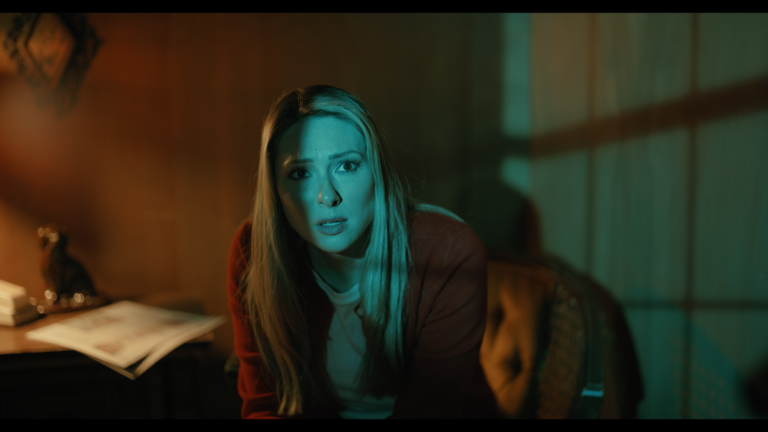
Where Nine Black Cats shines is the technical aspects of the movie. Cinematographer Justan Floyd delivers brilliant camera work in this film. The use of depth of field in shots created a great sense of ambiance to beautiful rack focus shots alternating from the background to the foreground. There’s also the use of color which was done with beauty and precision. Lighting and shadows also were superb, it’s pretty clear that Floyd is a subject matter expert in the genre of film noir as well as pulp fiction graphic novels. All of the artistry is on full display in the cinematography and it’s very impressive. Floyd also gets creative with using dutch angles in various scenes and fisheye lenses. It added a great visual style to the movie that felt like it was its own character.
By the time Nine Black Cats pieces together its nightclub murder, mysterious blue powder, and government connections, I was more interested in what cinematographer Justan Floyd was doing with the camera than in what Joe Pacifico was about to uncover. There’s a good hook here. A cop and a waitress follow a murder investigation far enough to realize that some of the people Joe should be able to trust might have a stake in what stays buried. I wanted to feel his unease grow with every revelation, but Chris Zuhdi plays Joe with the same weary detachment whether he’s delivering a joke or reckoning with how far the corruption reaches. The masked men add to the film’s pulp sensibility, though the one who reminded me of Walter White briefly pulled me into an entirely different story. Floyd, meanwhile, understands how to make a scene feel like it’s hiding something. A shift in focus can make you reconsider what you were just looking at, and his use of color and shadow gives the film the texture of a pulp crime comic. I just wish I’d felt as much curiosity about the story as I did about what Floyd might reveal in the next shot.
Like this: Like Loading…