The Court of Arbitration for Sport has overturned Caf’s decision to hand the African crown to Morocco. Here is what happened, what the judges decided and whether it is really over.
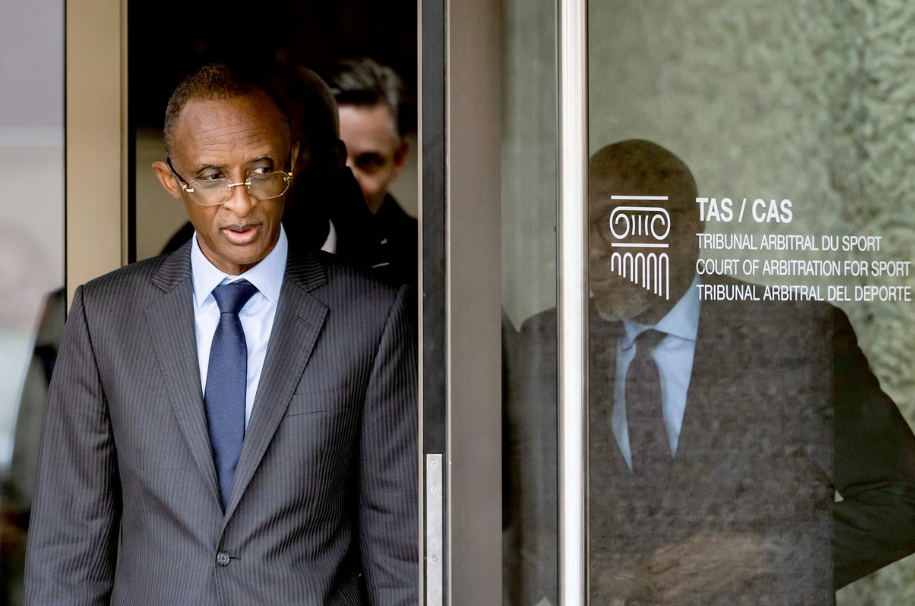
Abdoulaye Sow, secretary general of the Senegalese Football Federation, after the hearing on the FSF’s appeal against Caf and the Royal Moroccan Football Federation at the Court of Arbitration for Sport in Lausanne, 8 October 2026 © JEAN-CHRISTOPHE BOTT/AP/SIPA
Share
On 24 November the Court of Arbitration for Sport gave Senegal back their continental title, overturning the decision of Caf’s appeal board in favour of Morocco. Here is the reasoning behind a landmark award that reaffirms the absolute primacy of the referee on the pitch.
What happened in Rabat?
On 18 January 2026, Senegal beat Morocco 1-0 after extra time in the final of the 2025 Africa Cup of Nations at the Prince Moulay Abdellah stadium in Rabat. A long stoppage a few minutes before the end of normal time marred the match. Several Senegalese players, protesting against a penalty awarded to Morocco, went back to the dressing room for about 15 minutes. The DR Congolese referee, Jean-Jacques Ndala Ngambo, restarted play in the 109th minute (90+19), once both teams were back on the pitch.
How did Morocco end up with the title?
At first, they didn’t. Caf’s disciplinary board fined and sanctioned individuals from both teams but left the result alone. On 17 March, however, Caf’s appeal board ruled that Senegal’s walk-off breached articles 82 and 84 of the Afcon regulations. Article 82 says a team that leaves the pitch before the end of a match without the referee’s authorisation is considered the loser and eliminated from the competition. Article 84 sets the score at 3-0. Senegal were declared to have forfeited the final, and Morocco were handed the title in the boardroom.
What did Cas decide?
The Senegalese Football Federation (FSF) appealed to the Court of Arbitration for Sport (Cas), the highest tribunal for sporting disputes. A panel of three arbitrators heard the case in Lausanne on 8 October: Prof Gérald Simon of France, who presided, Prof Ulrich Haas of Germany and Prof Luigi Fumagalli of Italy. On 24 November it found in Senegal’s favour. Its 53-page award overturned the appeal board’s decision and reinstated the disciplinary board’s original ruling.
The panel first dismissed Morocco’s procedural objections. The Royal Moroccan Football Federation (FRMF) had argued that Cas had no jurisdiction over the case or over how the Laws of the Game should be applied. It also said the FSF’s appeal was inadmissible because it was lodged before Caf had issued its reasoned decision. Cas rejected both arguments, along with the FSF’s own procedural complaints against Caf.
Why did Senegal win?
The award rests on the “field of play” doctrine. Under it, a decision the referee takes on the pitch, with effects confined to the pitch, cannot be overturned unless the referee showed bias, malice, bad faith or arbitrariness, or made an error of law. The aim is to protect the finality and certainty of sporting results.
The FRMF argued that the offence under article 82 was complete the moment Senegal’s players crossed the touchline. Cas disagreed. It found that articles 82 and 84 apply only when a team’s conduct leads the referee to abandon a match for good, making a sporting result impossible. “It is for the referee, and the referee alone,” to judge whether play should resume or the match be abandoned, the award says. Law 5 of the Laws of the Game, laid down by the International Football Association Board (Ifab), reinforces that discretion.
By restarting the match, the panel found, Ndala Ngambo had “consciously and very clearly” judged that the conditions for abandoning it had not been met. He committed no error of law.
What about Morocco’s other claims?
The FRMF alleged that the referee had acted under pressure from a climate of violence orchestrated by Senegalese fans, players and their coach. It also claimed that Caf officials had told him to keep the match going. Cas dismissed these claims for lack of evidence or corroborating testimony.
Is it over?
Not as far as Rabat is concerned. Shortly after the award, the FRMF alleged that Haas had spoken by phone with the FSF president, Abdoulaye Fall, 48 hours before the decision. The claim has not been corroborated, and Fall firmly denies it. The FRMF also argued that Cas had ignored recent Ifab and Fifa guidance on players leaving the pitch without permission, and vowed to “pursue all available legal avenues”.
Its options are thin. A challenge before the Swiss Federal Supreme Court can succeed only on narrow grounds tied to flaws in the proceedings. Even then, the case would go back to Cas. “Do you think it would say that its doctrine and its settled case law on the field of play had changed? No!” said Seydou Diagne, one of the FSF’s lawyers.
Fall, for his part, said Cas had “done justice to sport” and stressed the “bonds of brotherhood” between Senegal and Morocco.
Mehdi Ba