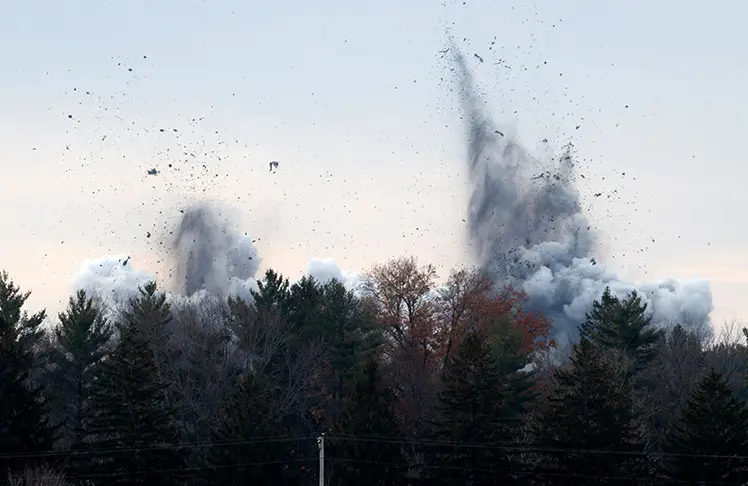
Debris flies into the air after the Army detonated several tons of degraded lead azide on the grounds of the Iowa Army Ammunition Plant on November 25 in Middletown, Iowa. (Scott Olson/Getty Images via CNN Newsource)
By Danya Gainor, CNN
(CNN) — Two hazy plumes rose over the Iowa Army Ammunition Plant Wednesday morning, punctuating days of legal battles and public outcry over the Army’s plan to detonate nearly five tons of deteriorating lead azide. Yet as the sky cleared over Middletown, a central question for residents remained unanswered: when they could get back to normal life.
Hours after the controversial detonation, some residents were still away from their homes under an evacuation recommendation meant to protect them from potential exposure to dangerous lead particles. Others had been told to shelter in place for their safety as some of their backyards served as testbeds for working researchers.
But even with an “all clear” from officials, which came through nearly nine hours after the detonation, returning home is only the first step, with more extensive soil and air testing still ahead to determine what the blasts left behind.
- Advertisement -
“We will continue working with Iowa officials and our federal partners to assess potential health risks, share findings, and respond to residents’ needs,” Health and Human Services Secretary Robert F. Kennedy Jr. wrote on X. “Iowa families deserve clear answers about what the monitoring shows, what remains under investigation, and what they should do to protect their health.”
While federal officials have acknowledged their responsibility to track any fallout, saying EPA monitoring systems have shown no airborne lead in the hours after the detonation, they have offered few details on what that oversight will look like or how far it will go.
Residents get the all-clear hours after blasts
The Army announced an all-clear for residents just after 6:30 p.m. ET, saying government mapping has detected zero airborne lead.
The Army added: “Post-detonation surface sampling is underway, and results will be released once complete.”
- Advertisement -
Outside of the immediate evacuation zone, residents within 20 miles of the plant had been advised to stay indoors and keep the windows closed.
By Wednesday night, residents were told the “shelter-in-place order has been lifted, and Iowans in the affected area can safely resume normal activities,” officials said in a joint release issued by FEMA.
The agency had offered lodging to those who chose to leave through Friday.
There’s no safe amount of lead in the human body, said Dr. Dan McCabe, medical director of the Iowa Poison Control Center.
“So even small amounts in children or patients or pregnant individuals can cause long-term health effects, and they can be mild long-term health effects or severe,” he said.
About 350 farms could also be affected based on the expected direction of the plume, according to the US Department of Agriculture, and farmers are advised to work with veterinarians to monitor their livestock in the coming days.
“It is best practice to power wash the outside of barns and buildings, fencing, livestock feeders and portable water tanks, trailers, grooming supplies and other farm equipment after the dust particles settle,” says an advisory from the Iowa Department of Agriculture and Land Stewardship.
The EPA also said it will be doing air monitoring and sampling in the field and is offering those services to people in the affected area.
For Ryan Marquardt, a farmer and vice president of the Iowa Farmers Union, he is left with one main concern — when would impacts manifest from potential lead exposure?
“Would they be immediate?” he told CNN’s Isa Soares. “You know, an acute exposure would be — you get an immediate result, but you know, in this case, if it’s a more diffuse exposure, would that, could that take months or even years to manifest anything?”
‘Zero airborne lead’ isn’t the end of the testing
Hour after hour, updates from the EPA’s monitoring tools in the wake of the blasts painted an encouraging picture, showing airborne lead levels holding steady at 0.0.
Acting Army Secretary Adam Telle and others touted the readings on X, thanking President Donald Trump for providing the “fix” to Middletown’s lead problem.
But researchers stress that when the dust settles, literally, there is more testing left to be done.
“There needs to be surface testing, soil testing. All those other testing have to be rolled out in the coming days to weeks to really be reassured,” McCabe said.
EPA personnel and contractors were on-site collecting more than 1,500 samples — including land, air, dust and water — before the detonation, and were collecting samples after the detonation on Wednesday and Thursday, the EPA has said. On Wednesday alone, more than 130 sites that were sampled pre-detonation were sampled again, the agency said.
On Thursday, EPA workers and contractors were taking samples at schools, playgrounds, daycares, churches and other places in the area. The agency said it intended to conduct a second round of drinking water sampling Thursday, and “further sampling in agricultural ponds in Missouri will continue.”
The EPA planned to conclude soil and dust sampling by the end of Thursday, the agency said, and it could start getting lab results from the post-detonation sampling as early as Friday.
The EPA will “continue its presence on the ground for as long as needed to ensure the proper environmental monitoring is taking place following the successful controlled detonation,” it said Thursday.
“There’s a lot of questions about what’s being done federally. Like … what is the radius over which they’ll do things like soil samples?” David Cwiertny, an engineering professor at the University of Iowa, said Wednesday. “The biggest question is, what is the timeline at which this all gets returned back?”
Cwiertny and his colleagues are independently monitoring for any potential air and soil contamination in the area.
He said they will be analyzing the soil and dust samples as quickly as they can and get them co-validated by an independent certified lab to “show that we’re doing things right and that people can trust the data we’re generating under these circumstances.”
While the EPA’s data is promising so far, “there’s a little bit of needing to wait and see, simply because things that can be measured in real time tend to not have the same sort of resolution or rigor that might be able to be achieved, say, through laboratory analysis,” Cwiertny told CNN’s John Berman.
Once a lab gets the samples, it can take “anywhere from 24 hours if it’s expedited, to longer,” depending on who is doing the lab work, he said. The holiday can also slow that process, he added.
Shannon Bartelt-Hunt, professor and department chair of the engineering department at University of Nebraska, said the government partnering up for “community-based science” can be a big help.
She said her lab will look at the topsoil from before and after and extract the lead and analyze it, because even if it is important to know what’s there since there’s no safe level of lead. Bartelt-Hunt said she told her citizen scientists not to go back and get samples until the area gets the all-clear.
Incoming Iowa leaders call for transparency
Coupled with local officials’ relief that the detonation went off as planned – apparently eliminating danger to Iowans – are echoing calls of transparency into why the stockpiled explosive material was able to deteriorate.
“The lead-up to the detonation should never have been so chaotic and unclear,” Iowa’s governor-elect, Democrat Rob Sand, said Wednesday. “Iowans across the state are understandably alarmed and scared. There must be immediate transparency to understand how and why this situation became what it did.”
Anyone impacted must be taken care of, he said.
Lindsay James, who was recently elected to Iowa’s 2nd Congressional District, is also calling for “accountability and transparency.”
“I need answers, we all need answers, Iowans deserve answers,” she told CNN’s Erin Burnett. “How did we get here in the first place? And how are we going to make sure this will never happen again?”
How we got here
Lead azide, a volatile material used to detonate munitions, has long been stored behind the guarded gates of the Iowa Army Ammunition Plant — where the state’s flat, southeastern cornfields suddenly give way to the high-security military installation spanning roughly 19,000 acres.
The World War II-era ammunition plant has run assembly lines for artillery shells and warheads using live explosives for more than eight decades. The site occupies nearly 30 square miles of rural Des Moines County, bordering Middletown, with a population of less than 400.
The Army notified the Environmental Protection Agency on or about March 12 of degraded material, according to court filings. But as far back as January, the Army activated a multi-agency working group to explore potential treatment alternatives to detonation, the filings show.
The EPA issued a permit effective November 13 that allowed for continued storage but went further than other permits to authorize a controlled detonation “in order to safely manage the explosive hazard and mitigate the imminent threat to the surrounding community and the environment.”
Local residents have decried the detonation plans, fearing for their safety and the integrity of their property. Environmental groups swiftly filed a legal challenge that briefly paused, but failed to stop the detonation, with the government making clear that the Army intended to proceed anyway under an emergency exemption.
In the end, a wave of federal agencies descended on the Hawkeye State this week, outnumbering Middletown’s own population.
The-CNN-Wire
™ & © 2026 Cable News Network, Inc., a Warner Bros. Discovery Company. All rights reserved.