Huge swathes of Côte d’Ivoire’s forests have been lost to cocoa production due to the giant demand from Europe and the West. Now the problem is spreading to Liberia. The forces driving the expansion describe how the EU’s new deforestation law can help stop the destruction.
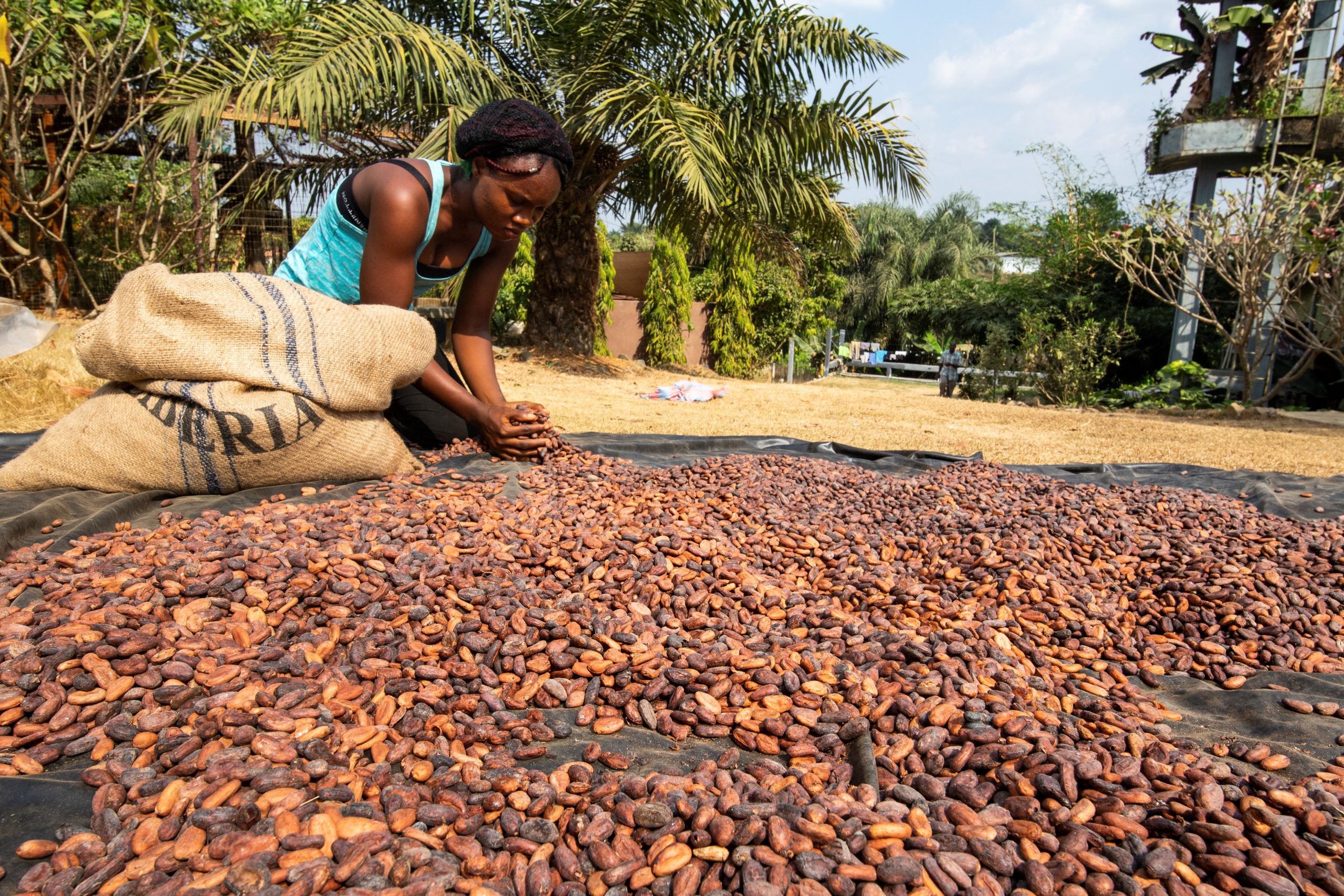
Freshly harvested cocoa beans in Nimba County, Liberia. (File photo: 1 February 2019) © Carielle Doe/AFP
Share
Cocoa is one of the world’s most popular and heavily traded agricultural commodities. Yet its recent history is volatile. In 2024, cocoa’s global price quadrupled to record highs, with one market analyst lauding it as “better than bitcoin”. Then prices crashed, before recovering this year.
More than anyone, small-scale cocoa farmers in West Africa have borne the brunt of this turbulence. Their natural environment – West Africa’s largest tropical rainforest – has also paid the price. Europe, the world’s biggest importer of cocoa, and by far the largest importer of Ivorian cocoa, can play an important role in stabilising the situation, particularly through the bloc’s deforestation regulation, which is now coming into force. But that law alone won’t be enough to stave off a crisis.
Farmers suffer
Cocoa farmers, most of whom live well below the poverty line, have seen their livelihoods buffeted by fluctuating cocoa prices, as well as the changing climate. El Niño’s severe droughts and heavy rains pose the latest threat to their prospects. Côte d’Ivoire – the world’s largest cocoa producer – is expected to see its output fall by around a fifth.
Cocoa is the only way we know to survive
Rampant deforestation is another serious challenge for Ivorian farmers. Over the past half century, more than 80% of Côte d’Ivoire’s forests have vanished, and most illegal deforestation there is related to cocoa production. It is a vicious cycle: intensive cocoa farming degrades the soils and reduces cocoa production over time, driving farmers to clear more tropical forests to plant cocoa trees.
However, Côte d’Ivoire’s increasingly nutrient-poor soils and razed forests are limiting the scope for establishing new plantations. And the cocoa price is too turbulent and low for farmers to be able to make a long-term shift to more nature-friendly agricultural practices. So, they’re pushing into new frontiers in neighbouring Liberia, where the deforestation continues.
A report that we coauthored for the Ivorian non-profit IDEF and Liberia’s Save My Future Foundation (SAMFU) offers insight into this disturbing trend. We recorded how Côte d’Ivoire’s cocoa crisis is spreading into southeastern Liberia, specifically the Taï–Grebo-Krahn–Sapo (TGS) forest complex, part of the Upper Guinean forest, a unique ecosystem and West Africa’s largest tropical rainforest.
For the report, our team interviewed 117 people across 10 Liberian towns, including area and traditional chiefs, women’s and youth leaders, farmers and community members, as well as security personnel and cocoa producers from Côte d’Ivoire. We pinpointed 26 cocoa farms using GPS, including 11 inside the protected Grebo-Krahn National Park, where clearing forests for farmland is illegal.
Low cocoa prices don’t prevent deforestation
Our fieldwork and analysis confirmed a finding that may appear counter-intuitive: a fall in the price of cocoa does not reduce deforestation. If anything, it tends to exacerbate it. When we look at what has happened in Côte d’Ivoire over the past 20 or 30 years, the trend makes sense. Poverty and the lack of alternative opportunities, among other factors, appear to be reinforcing peoples’ reliance on cocoa.
It is a major mistake to think that a higher price would act as an incentive against further deforestation
“Even if the price is low, we will keep farming because there is nothing else we can do,” one man told us, echoing other interviewees, including a woman farmer who said, “cocoa is the only way we know to survive”.
It is a major mistake to think that a higher price would act as an incentive against further deforestation. This mistake has been made in the past, and we can see the result in Côte d’Ivoire. Low cocoa prices lead to the destruction of more forests.
We also documented how structured migration networks are facilitating the expansion of cocoa farms: experienced farmers are leaving ageing, less-productive plantations in Côte d’Ivoire, while younger workers are being recruited through intermediaries to clear forest and establish cocoa plantations in Liberia.
The recruitment pipeline is deliberate, systematic and carefully planned rather than random or disorganised: canoes carry young men across the Cavally River from Côte d’Ivoire on fixed days, close to 1,000 people since January, according to one canoe captain.
While the encroachment in Liberia is relatively new, the enormous toll that cocoa production has taken on Côte d’Ivoire’s forests is a warning of what could come. But we still have an opportunity to prevent the same level of devastation on the largest remaining blocks of the Upper Guinean rainforest in Liberia.
European hope?
Our best hope is in the EU Deforestation Regulation (EUDR) that comes into force on 30 December for medium and large operators. Critically, the new law will forbid European buyers from importing cocoa and other commodities that come from illegally deforested land, or land that was deforested or degraded after 31 December 2020. The UK is introducing similar legislation.
The point of no return has not yet been reached
The EUDR will provide a big economic incentive for cocoa-producing countries, like Liberia, as well as companies and smallholders to ensure that their cocoa cultivation respects human rights and is deforestation-free. Given cocoa expansion from Côte d’Ivoire to Liberia is part of a transnational system, tracing illegally sourced cocoa once it enters established supply chains presents considerable challenges.
READ MORE Is the World Bank retreating on climate finance?
Even if it is well enforced, the EUDR alone will not be enough. It must be accompanied by other concrete measures, including support for countries in establishing robust national traceability systems, and support for the hundreds of thousands of small-scale producers whose livelihoods depend on cocoa farming. The areas where cocoa farms are expanding also need infrastructure development and stronger land governance.
Stopping the destruction of this precious ecosystem requires long-term cooperation between Liberia and Côte d’Ivoire, involving government agencies, local communities, civil society organisations and the private sector, and strengthening the existing joint Liberia-Côte d’Ivoire transboundary monitoring mechanism for migration flows and cross-border trade, with a focus on cocoa.
The situation we found on the ground is dire, but the point of no return has not yet been reached. The window of opportunity to act is closing fast. No one will be able to say they weren’t aware of the impending disaster.