Following the milestone Dangote refinery IPO, African policymakers must expand financial inclusion targets beyond basic bank and savings accounts to include retail investment accounts.
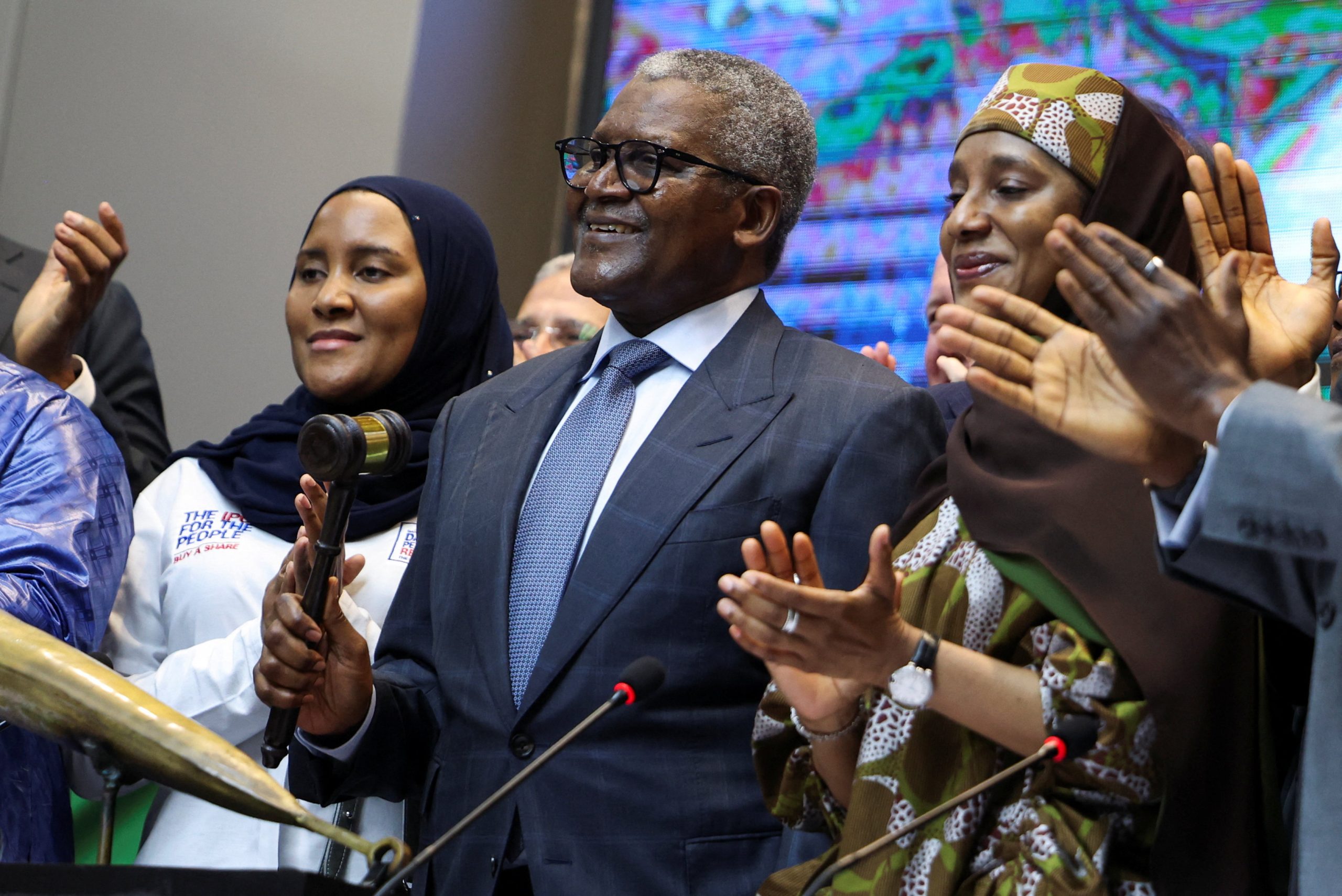
Aliko Dangote, president and CEO of Dangote Group during the opening day of his refinery’s initial public offering (IPO) at the Nigerian Exchange (NGX) Group in Marina, Lagos, Nigeria, on 14 September 2026. © REUTERS/Sodiq Adelakun
Share
The Dangote refinery IPO, which concluded its share subscription last month, marks a breakthrough for African stock markets. The offer drew four million unique subscription applications, and the final number is likely to rise once pension fund subscriptions are included. This could put it on par with Aramco’s 2019 IPO, which had 5.1 million subscribers. The Dangote IPO has surpassed previous listings on the continent, such as Kenya’s Safaricom, which had 840,000 subscribers.
Dangote framed the offer as a “People’s IPO,” saying he wanted cooks, gardeners, and drivers to own shares. He set a target of 10 million retail investors. This was a deliberately bold goal, given that the Nigerian Exchange (NGX) has only 2.7 million active investors. The IPO did not reach 10 million, but its four million applications already exceed the exchange’s entire active investor base.
Bringing more than seven million Nigerians, completely new to investing, into the market in a short time span is difficult. It requires long-term outreach and education efforts to persuade Nigerians of the importance of investing and its contribution to wealth building – not unlike the decades-long campaign to increase bank account ownership in Africa.
To build on the strong momentum unleashed by the IPO, capital markets stakeholders, from government to policymakers to donors, should rethink financial inclusion, expanding targets beyond simple transaction accounts to include investment accounts.
Africa’s financial inclusion blind spot
In Africa, the financial inclusion discourse remains stuck on the first rung of the ladder: basic payment and savings accounts. Significant progress has been made at this level, with bank or mobile money account ownership reaching 58% among adults in sub-Saharan Africa in 2024, according to the World Bank, up from 34% a decade earlier. This rapid growth has been fuelled by a surge in fintechs, mobile money providers, and agent banking. The Central Bank of Nigeria (CBN) is seeking to further expand digital payment channels.
READ MORE Nigerian stocks sink as investors position ahead of Dangote refinery IPO
The number of savings accounts in Africa has also increased dramatically. In 2021, just 18% of Nigerian adults used a formal financial account to save money, according to the World Bank. That figure surged to 43% in 2024, one of the sharpest increases in the world.
However, owning a savings account is not a guaranteed way for individuals to grow their wealth. In Nigeria, parking money in a savings account makes little financial sense, even after two years of disinflation. Nigerian banks now pay savings depositors around 8%, a floor mandated by the CBN. However, despite easing from a punishing 33% peak in 2024, inflation still hovers at 15% to 16% as of early 2026.
Investing is a much more viable option for outpacing inflation – the NGX returned 51% in 2025 alone and has compounded at 18.4% per year over the past decade. However, current definitions of financial inclusion exclude the investment accounts that would enable ordinary Nigerians to benefit from this growth.
Bringing ordinary Africans into markets
As a result, while overall statistics on financial inclusion show a positive trend, once investment accounts are considered, the situation appears far less rosy. Access Bank estimates that only 20 million Africans (around 1.2%) have investment accounts, compared with its estimate of 640 million to 700 million who have some form of payment or savings account.
Once Dangote IPO shares begin trading in December, millions more will become active retail investors, deepening local capital markets and giving local businesses a much-needed boost. Over the last 25 years, African companies have raised only about 1% of global equity capital. On top of that, around 80% of rated African sovereigns are labelled high risk, largely because their debt is in foreign currencies, making them vulnerable to exchange-rate volatility.
READ MORE Nigeria: Why Dangote is keeping an oversubscribed IPO open
For a continent that aims to borrow on its own terms and in its own currency, a solid domestic investor base capable of absorbing that debt and equity is essential. By drawing $4.5bn in investor interest, more than three times its $1.6bn fundraising target, the Dangote IPO shows that African businesses can turn to local stock markets to raise capital.
The Dangote refinery IPO is an opportune moment to reframe what constitutes financial inclusion in Africa, including investment accounts. India can serve as a model, where the number of retail investors grew to 130 million in 2025, up three-fold from 2019. This trend is geographically widespread, with high ownership levels in the “BIMARU” states (Bihar, Madhya Pradesh, Rajasthan, Uttar Pradesh), which have historically performed poorly on economic and financial inclusion indicators.
Encouragingly, this rapid expansion of the domestic investor base has not been technically difficult to achieve. Ordinary people who set up bank accounts during India’s earlier, digital-focused financial inclusion push have been able to open trading accounts without difficulty, thanks to fintechs and brokers using banking rails.
Earlier this year, the CBN announced an ambitious new financial inclusion target of 95% by 2028. Yet this target refers only to access to basic bank accounts. The Dangote IPO has successfully encouraged a large swath of Africans to invest in the stock market. To maintain the momentum, relevant stakeholders, from central bank authorities and the securities and exchange commission to donors and banks, should include brokerage accounts in financial inclusion targets.