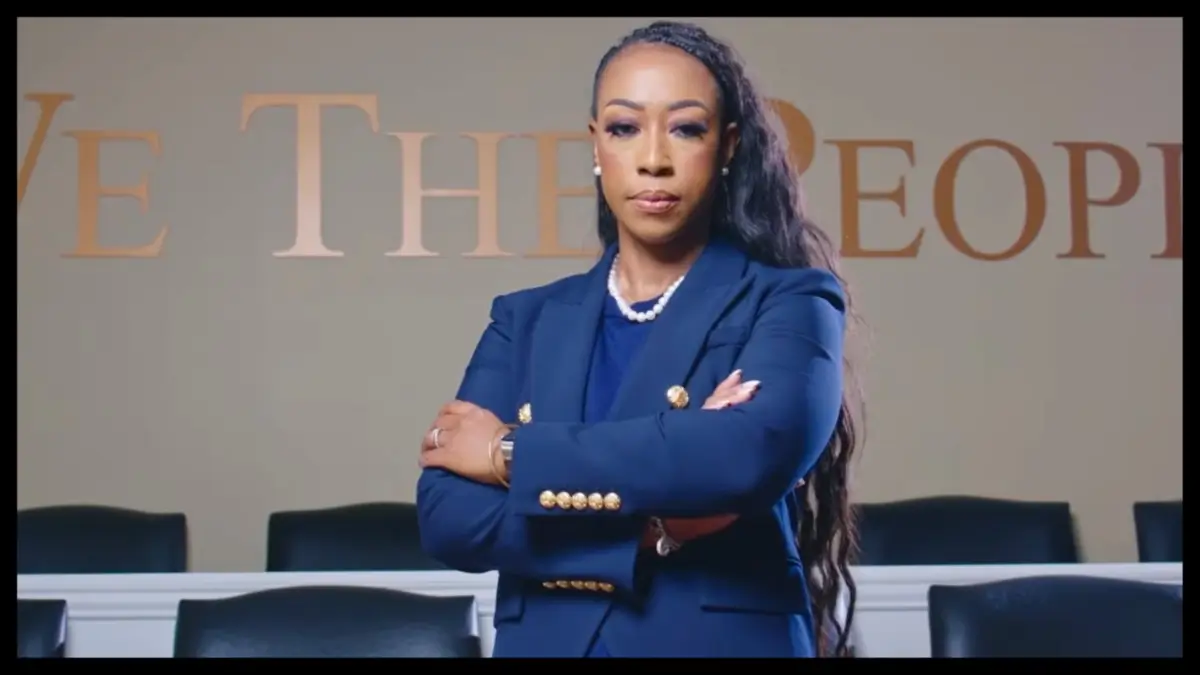
Amber Givens, the District Attorney-Elect of Dallas County in Texas. (Photo: Amber Givens website video screenshot)
Amber Givens is poised to become Dallas County’s first Black woman district attorney, a win made more meaningful by her fight to clear her name after allegations of judicial misconduct.
Before she takes office in January, though, she faces a staffing exodus, with dozens of prosecutors and other employees already gone.
Givens spent 11 years as a felony court judge before resigning in December 2025 to challenge two-term District Attorney John Creuzot. She upset Creuzot in the Democratic primary in March.
Controversy plagued her tenure as a judge, with complaints alleging that she mistreated attorneys and litigants, showed bias toward some defense attorneys and mishandled recusal motions. Those complaints led to a formal investigation by the Texas State Commission on Judicial Conduct in 2024.
In June 2025, the commission issued Givens two public reprimands and two public admonitions over allegations of judicial misconduct. Among the issues cited were her failure to hear and decide a matter assigned to her, failure to treat attorneys with “patience, dignity and courtesy” during hearings in her court and her decision to allow her court coordinator to preside over a Zoom bond hearing in 2021. Critics characterized the Zoom hearing as allowing her aide to “impersonate” her.
The controversy followed Givens into her campaign to lead Texas’ second-largest prosecutorial office, which handles about 60,000 cases a year. Although she faced no Republican opposition in the general election, Dallas attorney Eric Reed, who identifies as a moderate independent and previously worked in the Dallas DA’s office in the 1990s, entered the race in August as a write-in candidate.
Reed told the Texas Observer, “As soon as [Creuzot] lost, I mean, it was almost like a flood of people, both Republicans, Democrats, saying ‘my God, this is going to be a disaster.’”
Reed highlighted Givens’ lack of experience as a prosecutor in his campaign. While she presided over felony trials as a judge, she has never prosecuted a felony case in Dallas County — and would now be in charge of all prosecutions in the county, which includes 31 cities, including Dallas.
“When you’re trying to form a baseball team, you hire Babe Ruth, Willie Mays, Hank Aaron, Pudge Rodriguez, Yogi Berra, Mickey Mantle, Cal Ripken, Brooks Robinson, and you don’t hire the umpire to play the game,” said Reed.
Givens, who campaigned on restoring public trust through fairness and transparency, successfully challenged the judicial misconduct sanctions.
In July, the Texas Special Court of Review dismissed all sanctions against Givens following a two-day trial, finding that the commission failed to prove “each and every charge.” The court heard testimony from 17 witnesses, including Givens and Creuzot. The court also reviewed hundreds of documents and video evidence.
In its opinion, the three-member judicial panel described Givens as “certainly a polarizing individual,” but noted that the evidence also exposed significant shortcomings in the Dallas County District Clerk’s software. Those deficiencies, the panel said, made it difficult for judges to determine whether someone had filed a recusal motion or whether the court had granted it.
Givens faced accusations that she disregarded recusal notices prosecutors filed and continued to preside over cases outside her assignment — conduct that, if substantiated, could constitute a serious abuse of judicial authority. In one case, she allegedly ordered an individual jailed as a condition of probation. In another, she reportedly deemed a defendant’s bond insufficient and ordered the defendant arrested.
She argued that the county’s case-management software continued to identify her as the presiding judge, leaving her unaware that the court had removed her from the cases. Testimony from a retired judge assigned to her recused cases supported her account.
The three judges also seemed to find Givens credible when she testified that she had not allowed her former court coordinator Arceola Warfield to impersonate her during a Zoom hearing. Givens testified that she was working remotely, called Warfield by phone and instructed her to hold the phone up to Warfield’s computer so Givens could preside over the hearing herself.
After she prevailed with the Special Court, Givens said, “For six years allegations were used in an attempt to diminish my integrity. I trusted the truth enough to insist that it be tested…. Justice is about having the courage to follow the evidence wherever it leads and the integrity to accept the truth wherever it’s found.”
She and her attorney Chip Babcock told local CBSNews reporters that she believed she was the target of a political witch hunt led by trial lawyers who don’t like her and wanted her off the bench.
Ed Gray, a human rights activist and local podcaster, wrote in a 2022 editorial in the Dallas Weekly that members of the Dallas Criminal Defense Lawyers Association (DCDLA) were angry with Givens for successfully pushing to add an anti-discrimination clause to the Dallas District Court Plan (DDCP). The plan establishes procedures for appointing attorneys to represent indigent defendants in the district courts where Givens presides.
“These lawyers, backed up by the DCDLA board, didn’t like the fact that a young Black female judge was able to have language added to the DDCP that jeopardized their case assignments, i.e., one of their income flows,” he posited.
The anti-discrimination policy disqualifies attorneys from county court appointments to represent indigent defendants if they use “inappropriate language” or engage in conduct that demonstrates bias or prejudice based on “race, ethnicity, sex, age, religion, sexual orientation, etc.”
“In retaliation, the DCDLA launched a calculated campaign to smear Judge Givens’ reputation, with the ‘short-term goal of getting her charged (or at least investigated) with a crime, with the long-term goal being damaging her elections prospects,’” as evidenced by one board member’s statements in public discovery, Gray wrote.
Gray said the attorneys pursued a coordinated campaign, filing grievances with the Republican-dominated State Commission on Judicial Conduct and submitting more than 100 motions seeking Givens’ recusal on allegations of bias.
Now on the other side of that campaign, Givens said she has learned from being in the role of a defendant.
“To be the person accused of something … It showed me how horrible it is when a system is used as a weapon against people.”
Then she smiled, said the “personal digs” didn’t bother her and joked that she might order shirts that read, “I’m polarizing.”
Her “People Over Politics” campaign for district attorney focused on improving how the prosecutor’s office gathers and prepares evidence for trial. Givens argued that better evidence preparation would help prevent delays and stop prosecutors from taking cases to trial without sufficient evidence, which she described as a longstanding problem in Dallas County.
“Cases are moving without evidence, victims and accused individuals are left without answers, families are left in the dark, and political pressure has replaced principle,” she said in one of her campaign ads. Her proposed “evidence-ready prosecution standard” was intended to address those problems.
She promised to set up community justice councils “so every neighborhood has a voice in safety and prevention” and that “grand jury and plea policies will be transparent.”
Givens also pledged to reform the county’s diversion programs by partnering with nonprofits, hospitals, universities and philanthropic organizations to fund program slots offered on a sliding scale. “Because accountability should never depend on your ability to pay,” she said.
In October, she received an endorsement from prominent civil rights attorney Lee Merritt, whose law practice is based in Dallas.,
Merritt posted that he “stands with Amber Givens for Dallas County District Attorney. Justice demands more than promises. It demands transparency, accountability, and a commitment to the people. Amber Givens is running to rebuild trust through clear prosecution standards, evidence-driven decisions, and better communication with victims and families.”
On Nov. 3, Givens received 95% of the vote, while Reed, the write-in candidate, garnered 5%.
The next day, she posted on her Facebook page, “Dallas County, my heart is full. …Thank you for believing in me and what we will achieve together.”
Dallas County District Attorney-Elect Amber Givens posing on a subway train in Dallas, Texas after her election win in November 2026. (Photo: Amber Givens For Dallas County DA Facebook Profile)
As she often does, Givens has since been posting an array of photos of herself in fashionable outfits, gallivanting around Dallas.
“When God says yes, no one can say no,” she wrote on one post as she posed on a subway train.
But her transition has been a bumpy ride so far. Even before her victory, the Dallas County DA’s office was experiencing an exodus of staff.
On Oct. 29, the Dallas Morning News reported that 77 employees had submitted their resignations, including 47 attorneys. Those lawyers represent more than 15% of the office’s 273 budgeted attorney positions. At least 19 had served for more than a decade, taking valuable years of experience with them.
The office had 49 vacant positions at the end of October, compared to 33 in October 2025 and 23 in October 2024.
Reed, her rival in the general election, had made the staff departures a campaign issue.
He told the Dallas Morning News that attorneys’ willingness to leave rather than work under his opponent reflected a loss of confidence that could threaten public safety.
Givens has since made public statements promising to “lead a thoughtful, collaborative transition grounded in respect” for “the work of the county’s public servants” that emphasizes “continuity of service to our community … stability and professionalism.”
In a video posted on Facebook, she said, from Nov.17 to Dec. 15, that she and a panel of human resources professionals and other district attorney’s office leaders would be interviewing employees to learn about their experience, strengths and interests, and to find out “what you enjoy doing, and other initiatives you’d like to explore.”
On Monday, she posted that the transition team would notify any employee by Dec. 31 if there would be a change in their employment status. If they get no notice, she wrote, they should plan to continue serving in the office when her term starts on Jan. 1.
She also praised the DA’s office for its “talented, dedicated professionals whose experience and institutional knowledge are invaluable.” We recognize the uncertainty that accompanies a change in leadership. … We appreciate your professionalism, patience and commitment to public service as we prepare for the work ahead.”