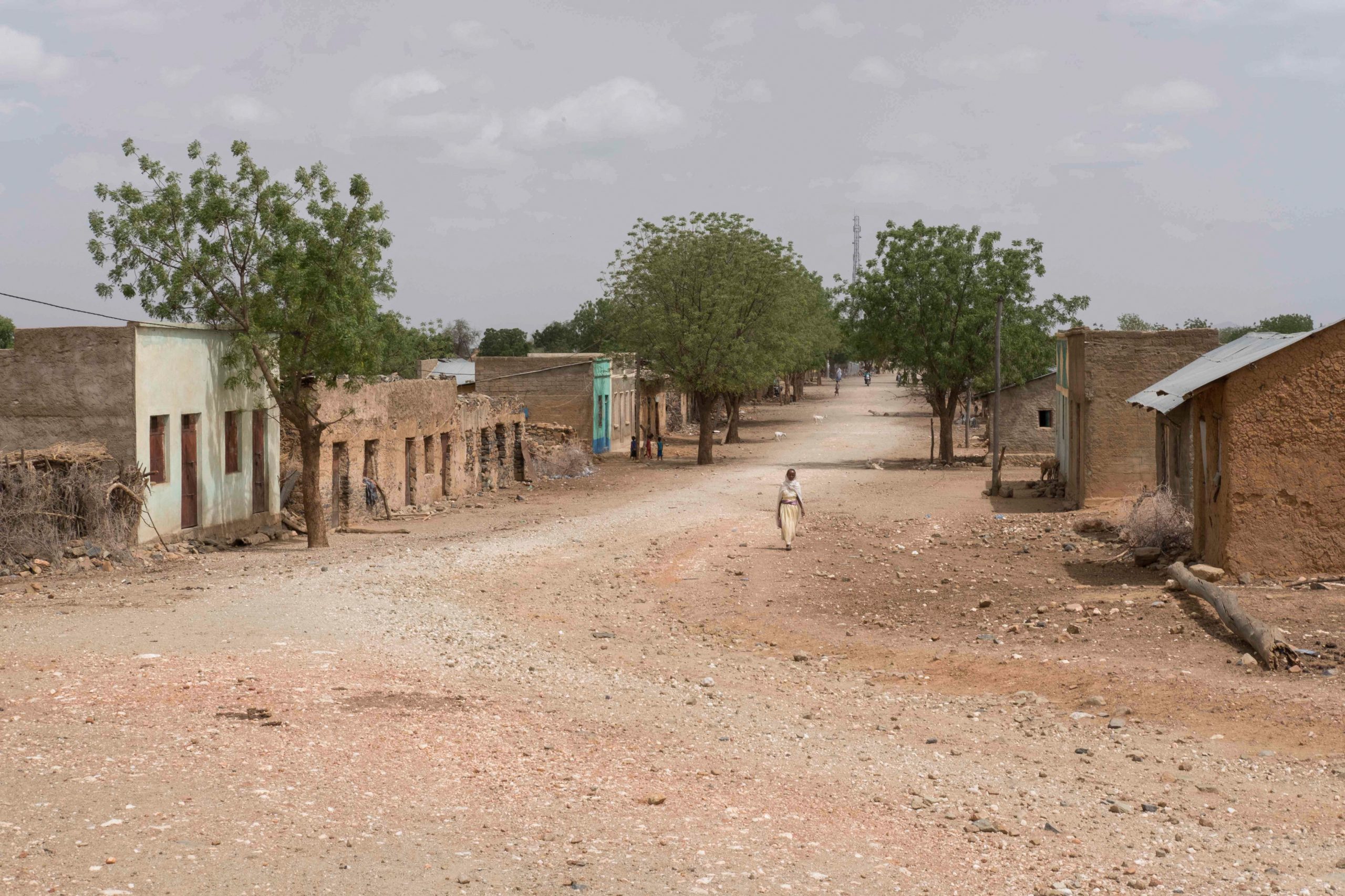
Eritrean troops have retaken Badme as reports of drone strikes and heavy artillery bombardments this week raise fears of another war over a town awarded to Asmara 25 years ago.
The main street in Badme, the border town between Ethiopia and Eritrea, in 2018. © Maheder HAILESELASSIE TADESE/AFP
Share
Nearly three decades after triggering a devastating war between Ethiopia and Eritrea, the small border town of Badme is once again a military flashpoint, with Eritrean troops back in control and Ethiopian forces advancing towards the frontier.
Eritrean forces regained control of the town around 15 November, barely a month after withdrawing, before deploying reinforcements and heavy weaponry towards nearby border villages, according to conflict monitor ACLED.
READ MORE Ethiopia’s Russian fighter jets raise stakes in Eritrea standoff
The armies of Ethiopian Prime Minister Abiy Ahmed and Eritrean President Isaias Afwerki are now within striking distance of each other, increasing the risk of another war between the two neighbours, whose 1998-2000 conflict killed tens of thousands of people.
Tensions escalated further on Wednesday night, when drone strikes and heavy artillery bombardments were reported around Badme.
Citing residents and a diplomat with access to military intelligence, Addis Standard reported that explosions continued into Thursday morning, with Eritrean forces reinforcing positions from Shambiko to Gemhalo and Sembel, while Ethiopian troops were concentrated around Geza Tegaru and nearby Lama hamlets.
Badme became the focal point of a much deeper political confrontation
The renewed tensions threaten to undo the landmark peace agreement Abiy and Isaias signed in 2018, ending two decades of hostility. Their relationship has since soured amid renewed fighting in Tigray, while Badme has become a flashpoint again despite a 2002 international ruling awarding the town to Eritrea.
Who controls Badme?
Why Eritrean forces withdrew from Badme around 12 October, only to return a month later, remains unclear. Jalale Getachew Birru, East Africa regional expert at the Armed Conflict Location & Event Data (ACLED), tells The Africa Report that “between 12 October and 14 November, no one controlled Badme, though Eritrean intelligence personnel have been sighted in the town on several occasions”.
Ethiopian troops and their allies, the Tigray Peace Forces, were still some distance away at the time. Federal forces entered nearby Sheraro on 3 November before pushing into the surrounding countryside, bringing them closer to Eritrean positions, Jalale says.
ACLED reported that Ethiopian forces shelled Hadish Mender, a village immediately adjacent to Badme, on 9 November, before drones targeted suspected Eritrean military positions three days later, prompting retaliatory artillery fire.
Following their return, Eritrean troops reportedly moved heavy military equipment towards Gual Gemhalo and Sembel, roughly 20km from Badme, where they reportedly established defensive positions.
Badme has re-emerged as a flashpoint in the current standoff between the Ethiopian National Defence Forces (ENDF) and the Eritrean Defence Forces (EDF)
Jalale believes Eritrea’s latest military build-up is aimed at protecting its border, rather than preparing an invasion of Ethiopia. Asmara considers Gemhalo and Sembel part of its territory, although their precise status remains disputed.
But Eritrea’s strategy, she argues, goes much further, seeking to keep Tigray hostile to Addis Ababa and create a buffer between the two countries. That, she says, explains why Eritrean troops entered the fighting in Tigray in October, seeking to stop Ethiopian forces and their allies from reaching the border and potentially taking the war into Eritrea.
Why Badme matters militarily
The town’s importance goes beyond the territorial rivalry between Addis Ababa and Asmara. Ethiopian peace analyst Mulugeta Gebrehiwot argues its geography makes it one of the most strategically important stretches of the border.
“Badme has re-emerged as a flashpoint in the current standoff between the Ethiopian National Defence Forces (ENDF) and the Eritrean Defence Forces (EDF) largely because of military considerations, although political calculations cannot be entirely discounted,” he says.
Ethiopia, he adds, has an advantage in artillery, mechanised equipment and air power, while Eritrea faces manpower shortages following years of emigration and demographic decline.
READ MORE No quick wins in the Ethiopia-Eritrea war of egos
Unlike the “rugged and mountainous terrain” that characterises much of the Ethiopia-Eritrea frontier, he notes the Badme sector consists largely of open plains that are “highly conducive” to mechanised operations and air-supported offensives.
“The relatively flat terrain extending toward Barentu provides favourable conditions for manoeuvre warfare and makes defensive operations more difficult for the EDF than on the heavily fortified and topographically advantageous Zalambesa and Tsorona fronts,” Mulugeta says.
Previously, it was Badme; today, it is Assab. The real issue is the political and strategic direction of the region
The route also offers access to Eritrea’s western lowlands and, potentially, its central highlands, making it particularly sensitive for Asmara.
Badme’s proximity to war-torn Sudan adds another strategic dimension. Mulugeta says fighting on both fronts could make the corridor crucial to Ethiopian military operations, allowing its forces greater freedom to manoeuvre and potentially coordinate operations along the Sudanese frontier.
A dispute settled in 2002
Badme triggered the May 1998 war between Ethiopia and Eritrea, five years after Asmara gained independence, with a border dispute escalating into two years of fighting involving tanks, trenches and heavy artillery.
The December 2000 Algiers Agreement ended the war and established an independent boundary commission, which awarded Badme to Eritrea in a final and binding ruling on 13 April 2002.
Ethiopia resisted implementing the decision until June 2018, when newly appointed Prime Minister Abiy accepted it, paving the way for reconciliation with President Isaias and his Nobel Peace Prize the following year.
But Horn of Africa analyst Habtom Ghebrezghiabher says the dispute over Badme was always about “far more” than territory, reflecting a “deeper political and ideological confrontation” between Isaias and the Tigray People’s Liberation Front (TPLF), which dominated Ethiopian politics after 1991.
The TPLF favoured a multinational federal system recognising Ethiopia’s ethnic and linguistic diversity and the right to self-government. Isaias opposed this model, arguing that ethnic federalism would divide Ethiopia and destabilise the region.
“Badme became the focal point of a much deeper political confrontation,” Habtom says, adding that even after the 2018 reconciliation, Isaias argued stabilising Ethiopia was more important than immediately demarcating the border, underscoring the political disagreements underlying the territorial dispute.
The rivalry has taken on a new dimension with Ethiopia’s push for access to the Red Sea. Abiy insists landlocked Ethiopia needs a port and wants a peaceful solution, but Eritrea sees a potential threat to its sovereignty, particularly over the port city of Assab.
“Previously, it was Badme; today, it is Assab. The real issue is the political and strategic direction of the region,” Habtom says.
Both sides, he warns, could use the fighting around Badme to justify their positions. Asmara could portray Ethiopian troop movements as evidence of wider territorial ambitions, while Addis Ababa could cite alleged Eritrean support for Tigrayan rebels as proof of interference in Ethiopia’s internal affairs.
A new enemy at the border
The confrontation has also turned former allies into adversaries. Eritrea fought alongside Ethiopia against the TPLF during the 2020-2022 Tigray war, but relations between Abiy and Isaias soured after the Pretoria peace agreement, to which Eritrea was not a party.
Now, Tigrayan forces that once fought Eritrea are battling Ethiopian troops, while Asmara stands accused of backing them, allegations it denies.
According to Jalale, fighters from the Alliance for Survival, including TPLF-led Tigray Defence Forces, the Amhara Fano National Movement and Afar Uguugumo, have been pushed towards Badme by Ethiopian troops and their Tigrayan allies.
“This is why the tension is escalating at this location,” she says.
Sheriff Bojang Jnr